“Absolutely love Gearset in almost every single way compared to Copado. Far more flexibility, integrations, and a better, cleaner user experience.”
Alex Louderback
Salesforce DevOps Engineer, National Philanthropic Trust
The key differences at a glance
Gearset is a cloud-native SaaS platform that covers the full Salesforce DevOps lifecycle; Copado is a Salesforce managed package that runs inside your org. Both handle core CI/CD and governance — here’s where they differ most.
Platform architecture
Gearset is a cloud-native SaaS platform that updates automatically with zero downtime. Copado is a managed package that lives inside your org — competing for governor limits and forcing quarterly upgrade windows.
Source control
Gearset is genuinely Git-first, comparing every environment against your repo continuously and flagging drift the moment it appears. Copado routes changes through a proprietary middle layer, so orgs can silently fall out of sync with source control.
Backup & data
Gearset gives you full metadata and data backup, point-in-time restore, archiving, and native data and CPQ deployments — all in one platform. Copado captures metadata snapshots only, leaving your data exposed.
Deployment success
Gearset's comparison engine and 100+ problem analyzers catch missing dependencies before you deploy, so releases go out right the first time. With Copado, teams routinely wrestle with failed deployments, missing dependencies, and manual rework.
Customer support
Gearset includes unlimited in-app chat with engineers who reply in about two minutes — no tiers, no tickets. Copado's tiered, ticket-based support can leave critical issues waiting for weeks.
Monitoring & observability
Gearset builds org monitoring, error tracking and observability right into the platform, so you catch problems before your users do. Copado has no equivalent monitoring at all.
“Gearset is the only clear choice at this point. Our releases have gone from 4+ hours with Copado to less than 45 minutes with Gearset.”
Salesforce Administrator & Deployment Team Lead
US public sector organization
Gearset vs Copado, feature by feature
A side-by-side look at how the two platforms compare across the full Salesforce DevOps lifecycle.
Gearset vs Copado — feature comparison
Feature
Gearset
Copado
Integrated AI agent
Yes — Gearset's agent is a virtual teammate that picks up tickets and builds the right change to deliver through your governed pipeline.
Partial — Copado's agents run per tool and require orchestration with another agent — all on a separate platform from its DevOps tool.
Org intelligence
Yes — Gearset combines deterministic analysis with AI for accurate results.
Yes — Copado relies solely on AI and requires a separate AI web app to configure metadata integration.
Modern SaaS app (no install/upgrades)
Yes — Gearset is a true SaaS app with daily, automatic updates.
Partial — Copado’s CI/CD platform is a managed package with manual installs and quarterly upgrade downtime.
Enterprise integrations
Yes — Gearset integrates with major ALMs and VCS providers with simple, click-based setup.
Yes — Copado integrations are more complex and require additional configuration.
Customer success & support
Yes — Gearset offers unlimited human support with an average 2-minute response time.
Partial — Copado uses a tiered, paid support model with bots and ticket-based help, and resolutions often take weeks.
Multi-platform & Salesforce Cloud support
Yes — Gearset supports Salesforce Platform, Experience Cloud, Revenue Cloud, Data Cloud, Agentforce and more.
Partial — Copado relies on community plugins and has limited cloud-specific support.
Smart metadata comparison & visualizations
Yes — Gearset provides visual diff tools for metadata like Flows and Lightning Pages.
No — Copado lacks comparable metadata visualization.
Complex deployment handling
Yes — Gearset analyzes dependencies and relationship trees to prevent errors before deployment.
Partial — Copado relies on AI suggestions that can be inaccurate.
Revenue Cloud (CPQ) deployments
Yes — Gearset deploys CPQ configuration and data natively, with an external ID setup wizard and dependency analysis that maps record relationships for you.
Partial — Copado’s external ID matching for data deployments is still in beta and needs its managed package installed in your org.
Observability
Yes — Gearset offers org health monitoring, API usage, error tracking and diagnostics.
No — Copado has no observability functionality.
Code reviews & development standards
Yes — Gearset enforces custom development standards, tracks tech debt and suggests fixes.
Partial — Copado relies on third-party scanners and PMD.
Backup, disaster recovery & archiving
Yes — Gearset provides full metadata + data backup, restore workflows and archiving.
No — Copado offers metadata snapshots only — there is no data backup or restoration feature.
Sandbox seeding & data masking
Yes — Gearset can mask in-place at scale (up to 2M records per run).
No — Copado has no in-org masking capability.
Automated testing
Yes — Gearset offers AI-powered UI testing as a quality gate in your pipeline — with natural language test creation.
Yes — Copado has Robotic Testing — a legacy, code-heavy solution that requires ongoing developer maintenance.
Monitoring, governance & compliance
Yes — RBAC, compliance controls, org monitoring, and code quality tools — plus real-time observability and CD rules built into every pipeline.
Yes — RBAC, compliance controls, and code quality tools available, but no org monitoring and no built-in CD rules.
Pipeline management
Yes — Cloud-native pipelines with no governor limits and no upgrade downtime.
Partial — Copado’s pipelines run inside the managed package on a fixed single-branch model subject to governor limits, and Agentia Advanced is capped at one production org.
Scalability
Yes — Gearset scales from your first deployment to enterprise, with no need to migrate or switch platforms as your team grows.
No — Agentia Advanced caps you at one production org, so growing past that means switching to Copado’s managed package.
Enterprise branching workflows
Yes — Gearset supports multiple branching strategies to suit Enterprise teams, including Gitflow.
No — Copado has a fixed, single-branching model.
Extensible quality gates
Yes — Quality gates and CD rules automatically block non-compliant changes from reaching production.
Yes — Teams can configure quality gates across environments.
Smart merge conflict resolution
Yes — Gearset offers semantic merge tools that learn from previous resolutions.
No — Copado’s auto-merge is confusing and prioritizes new changes, bypassing checks and risking code regression.
Environment syncing
Yes — Git-first syncing continuously compares environments against source control, flags drift the moment it appears, and makes back-promotion a few clicks.
Partial — Syncs through a middle cloud layer before your Git repo, so environments can drift from source control without you seeing it.
DevOps metrics
Yes — Gearset includes a built-in DORA metrics dashboard.
Yes — Copado provides value stream management and DevOps metrics.
3,500+ customers trust Gearset
99%
Deployment success rate
98%
Customer happiness
00:02:17
Support response time
42,769,853
Deployments
Already using Copado and hitting roadblocks?
If you’re wrestling with merge conflicts, failed deployments, or slow support, see how teams break free from Copado — with a guided, low-risk migration.
One platform that supports the end-to-end DevOps lifecycle
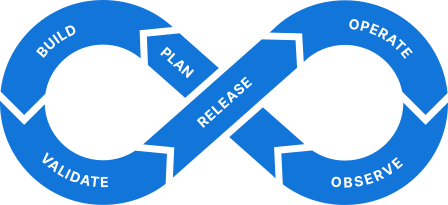
Gearset gives teams everything they need to manage the entire DevOps lifecycle in one end-to-end DevOps platform, all underpinned by enterprise-grade security and world-class support.
It just helps the team deploy so much faster. Especially when you have a huge team of people, Gearset makes tracking all those changes and coordinating deployments much easier
Deployments and code quality used to be a major topic in every project. Now? It’s barely a topic of conversation. Thanks to Gearset, deployments just happen.
Gearset is the best tool on the market to support and maintain a company’s Salesforce DevOps process. Gearset is faster and nimbler than Copado, yet provides all the DevOps functionality that a company needs, and more. Everyone at Gearset has been truly awesome.
Christian Klockare
Senior Salesforce Developer, Tanium
The best Salesforce DevOps platform for enterprise
Gearset combines advanced governance, compliance support, and scalable release management with a user-friendly interface and rapid onboarding. We support robust compliance — ISO 27001, GDPR, CCPA/CPRA, and HIPAA — and provide enterprise‑grade security controls and hosting, making Gearset well placed to handle regulated environments and data‑sensitive use cases. We give enterprises built‑in audit trails, SOX/ISO/HIPAA support, parallel pipelines for multiple global teams, and integrated security scans — all in one single platform.
Unlike Copado’s complex, heavy setup and maintenance, Gearset delivers enterprise‑grade power without the overhead, which is why leading global organizations in finance, healthcare, and technology choose Gearset to underpin their DevOps strategy.
Security you can trust
Gearset is ISO 27001 certified and offers you enterprise-grade security. Your Salesforce data and metadata are encrypted in transit and at rest, hosted on the same AWS data centers trusted by Salesforce, with 24/7 intrusion detection. Gearset is trusted by over 3,500 teams — including some of the world’s most complex orgs — who rely on secure, scalable, and forward‑thinking technology to power their Salesforce releases.
What is the difference between Gearset and Copado?
Gearset is a cloud-native SaaS platform that runs outside Salesforce and connects to your orgs through the Salesforce API, covering the full end-to-end DevOps lifecycle — metadata and data deployments, CI/CD pipelines, backup and restore, testing, code review and observability. Copado is a Salesforce managed package installed inside your org, so it is subject to governor limits and needs quarterly upgrades that can cause downtime. Both handle core CI/CD and governance; the biggest differences are architecture, deployment success tooling, native data backup and built-in observability.
Is Gearset or Copado the better Salesforce DevOps platform for my team?
It depends on your priorities. Teams comparing the two most often choose Gearset when they want a true enterprise SaaS platform, a high deployment success rate, built-in backup and observability, flexible branching, and fast human support included as standard. A feature-by-feature comparison shows exactly where each platform leads, so you can match them to your requirements.
How much does Gearset cost compared to Copado?
Gearset is priced as one all-inclusive platform, with transparent per-user pricing that covers CI/CD pipelines, deployments, data and CPQ deployments, backup and observability. Copado’s total cost usually spans several separate line items — a dedicated governance-org Salesforce license, per-pipeline procurement, a third-party backup contract, and separate implementation services and tiered support. Comparing like for like, teams generally find Gearset has a lower and more predictable total cost of ownership.
What deployment success rate does Gearset achieve?
Gearset customers achieve a 98% deployment success rate. Before any deployment, Gearset runs over 100 automated problem analyzers that detect missing dependencies, API version mismatches, metadata type conflicts, and Salesforce-specific issues that would otherwise cause a failure. When a problem is detected, Gearset provides a plain-language explanation and a one-click suggested fix — so teams resolve issues before deployment, not after.
Is Gearset installed inside Salesforce, like Copado?
No. Gearset is a standalone SaaS application hosted on AWS that connects to your orgs via API and runs entirely in the browser, with no managed package and no quarterly upgrades. Because it runs independently of your org, your pipelines, deployment history and backups stay available even if your Salesforce org has an outage — whereas Copado, running inside the org, becomes inaccessible when the org goes down.
Does Gearset include backup and disaster recovery?
Yes. Gearset includes full metadata and data backup, point-in-time restore, and archiving as part of the platform. Teams can recover from accidental deletions, configuration changes, or org corruption directly within Gearset. Copado offers metadata snapshots only — it does not include data backup or restoration capabilities.
Does Gearset have org observability and monitoring?
Yes. Gearset includes a built-in observability layer that monitors org health across Apex errors, Flow failures, API usage, and org limits — so teams can catch and address issues before they affect users or deployments. Copado does not have observability functionality. Teams using Copado need separate tooling for org health monitoring.
Which branching strategies do Gearset and Copado support?
Gearset supports multiple branching strategies, including Gitflow and expanded branching. Copado uses a fixed, single-branching model, so teams with different workflows have to work around its limitations.
How does Gearset handle merge conflicts?
Gearset uses semantic merge tools that understand the structure of Salesforce metadata, not just raw text. When a conflict occurs, Gearset presents a clear visual merge interface. It also learns from previous resolutions and applies those strategies automatically over time, reducing manual intervention for recurring conflict patterns. Copado’s auto-merge approach is confusing and prioritizes the most recent changes, which can bypass necessary checks and risk code regression. These can show up as “ghost commits” that don’t actually exist and cause the deployment to fail.
Can Gearset handle org comparisons on large orgs quickly?
Yes. Gearset uses incremental retrieval and caching when comparing large Salesforce environments, so comparisons complete quickly and can be refreshed frequently without lengthy waits. Gearset also provides visual diff tools built specifically for complex metadata types — including Flows and Lightning Pages — so teams see exactly what changed in a human-readable format rather than raw XML.
Is Gearset an enterprise-grade DevOps platform?
Yes. Gearset is a enterprise-grade DevOps platform for Salesforce, trusted by some of the world’s largest organizations — including McKesson, IBM, Johnson & Johnson, Zurich, and Sage. These are high-volume release environments with multi-org architectures, complex pipelines, and zero tolerance for compliance gaps. Gearset delivers the governance controls, built-in audit trails, and quality gates that enterprise teams need to release with confidence — at scale, without sacrificing speed.
How does Gearset's approach to AI differ from Copado's?
Gearset builds AI into a single governed DevOps platform, so every change — whether a human or an agent makes it — flows through the same analysis, testing, pipeline and audit trail. Its AI is grounded in your specific org through Org Intelligence, a deterministic map of your metadata and dependencies. Copado treats AI as a separate layer running alongside its DevOps tool, requiring its own app and configuration.
How do Gearset and Copado compare on governance and compliance?
Gearset is certified to ISO/IEC 27001:2022, and is compliant with GDPR, UK GDPR, CCPA/CPRA, and HIPAA. Gearset is hosted on AWS infrastructure that holds SOC 1, SOC 2, and SOC 3 accreditations. The platform’s governance controls — quality gates, audit trails, RBAC, and segregation of duties — are specifically designed to help regulated teams meet SOX requirements. Data residency options in the US, Canada, EU, and Australia give teams direct control over where data lives. SSO and MFA are supported via Okta, Azure AD, and Google Workspace.
Governance is built into the delivery process rather than sitting alongside it. Quality gates and CD rules block non-compliant changes from reaching production automatically. Configurable code review rulesets scan every pull request for Apex vulnerabilities, Flow issues, and deviations from Salesforce’s Well-Architected principles. RBAC, segregation of duties, and full deployment audit trails — version-controlled in Git — give regulated teams the evidence they need at audit time. PII data masking runs at scale across up to 2 million records, satisfying GDPR, CCPA/CPRA, and HIPAA requirements in lower environments.
Copado holds ISO 27001, SOC 2 Type 2, and FedRAMP Moderate (GovCloud only), HIPAA and CCPA/CPRA certifications. For teams outside US federal government, Gearset’s compliance posture is broader.
What onboarding and training does Gearset provide?
Gearset partners with customers from day one. Depending on your complexity, you will be assigned a dedicated Customer Success Manager, Onboarding Manager, and DevOps Architect at no additional cost. Onboarding is structured around each team’s existing setup, supported by a dedicated Onboarding Hub with resources and progress tracking, and followed by ongoing quarterly success reviews. Gearset’s DevOps Launchpad extends that further, giving teams role-based learning paths and certifications so the whole organization — not just the admins — builds real DevOps capability over time. The goal isn’t just a successful go-live. It’s making sure teams have the knowledge and support to keep improving long after launch.
See how Gearset stacks up against Copado — for your team.
A live walkthrough with your own orgs and use cases
Straight answers on migration, pricing, and support